
Call us
301-363-4651 (Available 9 a.m. to 5 p.m. CST from Monday to Friday)

| Code | CSB-RA010418A17me1HU |
| Size | US$210 |
| Order now | |
| Image |
|
| Have Questions? | Leave a Message or Start an on-line Chat |
| Application | Recommended Dilution |
|---|---|
| WB | 1:500-1:2000 |
| ICC | 1:50-1:500 |
| IF | 1:30-1:200 |
Histone H3.1 methylation at arginine 17 represents a critical epigenetic modification that influences chromatin structure and gene expression regulation. This mono-methylation mark participates in the complex histone code that governs transcriptional programs, making it an important target for researchers investigating epigenetic mechanisms, chromatin dynamics, and nuclear signaling pathways.
This recombinant monoclonal antibody, clone 3E10, offers the reproducibility and consistency that epigenetics research demands. Produced using recombinant technology with a defined sequence, it eliminates the lot-to-lot variability that can complicate longitudinal studies or multi-site collaborations. The rabbit IgG format, purified by affinity chromatography, ensures high specificity for the mono-methylated R17 epitope on Histone H3.1.
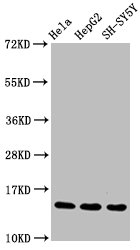
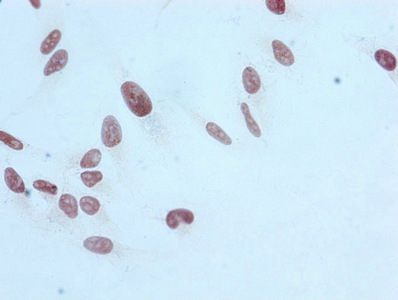
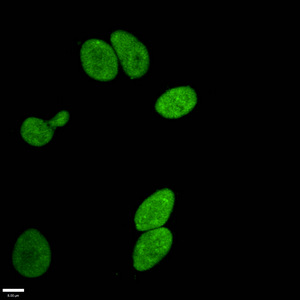
Validation across multiple experimental platforms demonstrates this antibody's versatility in your workflow. Western blot analysis confirms reliable detection of the expected 15 kDa band in HeLa, HepG2, and SH-SY5Y whole cell lysates, providing confidence across different human cell models. For spatial analysis of histone modifications, immunocytochemistry and immunofluorescence applications have been validated in HeLa cells, enabling visualization of this epigenetic mark within its nuclear context. The immunofluorescence data shows clear nuclear localization when counter-stained with DAPI, confirming appropriate subcellular targeting.
Recommended working dilutions span practical ranges for each application, from 1:500–1:2000 for western blotting to 1:50–1:500 for immunocytochemistry and 1:30–1:200 for immunofluorescence, allowing optimization for your specific experimental conditions. Whether you're mapping histone modification landscapes or investigating arginine methylation in disease contexts, this antibody provides a dependable tool for advancing your epigenetics research.
There are currently no reviews for this product.





